

After the PDF: How the Government Case File Should Work
What the next decade of public records will look like: administrative acts as signed data, verifiable identity as proof of authorship, and the architecture that supports both.


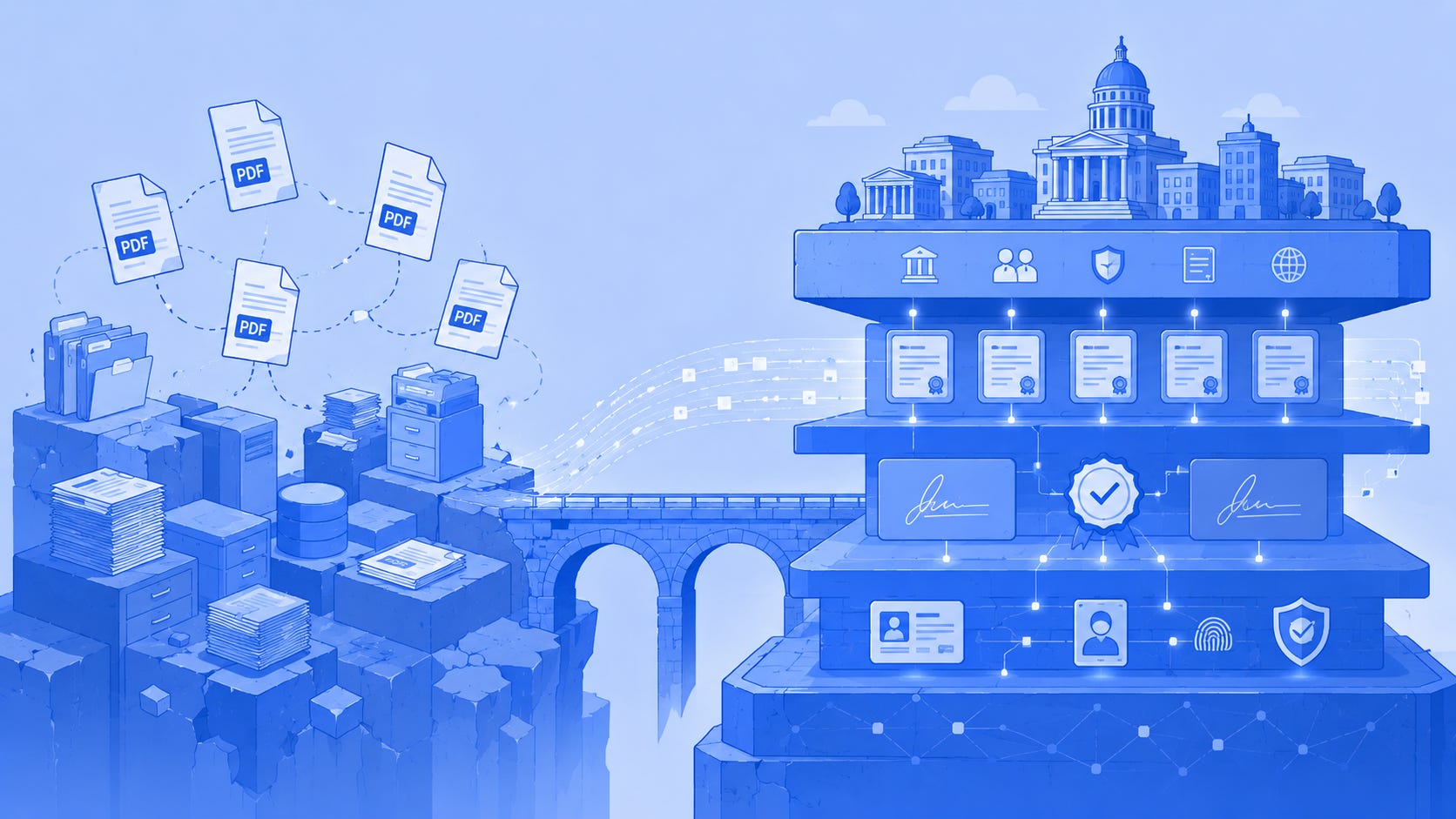
The case file is the backbone of state administration. Every resolution, every transfer and every official communication exists inside one. That is millions of proceedings per year, in every jurisdiction.
The first generation of electronic document management solved a concrete problem: replacing paper. And it did it well. Across much of Latin America, those systems reached real operational maturity and became critical State infrastructure.
But the question this decade faces is different:
What is an administrative document once it is born digital?
Leaving it unanswered has a growing cost. The US Government Accountability Office (GAO) documented that 80% of the federal technology budget is consumed operating and maintaining existing systems. Legacy systems end up charging a permanent rent on the capacity to innovate.
In the region’s federal countries, moreover, this discussion happens province by province. Each jurisdiction can decide its own technological evolution. Far from being a limitation, that diversity can become an advantage for modernizing gradually and under control, as we discussed with Gustavo Giorgetti on our podcast.
Our answer comes down to three claims:
1. Legal validity lives in the signature over the content; the format is merely a medium of representation. The region’s digital-signature laws, inspired by the UNCITRAL Model Law, and frameworks like eIDAS demand properties — integrity, authorship, certification and traceability — never file formats.
2. A document born digital works better as signed data than as a signed image. It is more efficient to search, process, archive and interoperate, with exactly the same legal validity.
3. Document integrity solves only half of the trust problem. The other half is proving who signed it. That layer is verifiable identity.
What changes in practice
Less infrastructure, more capacity
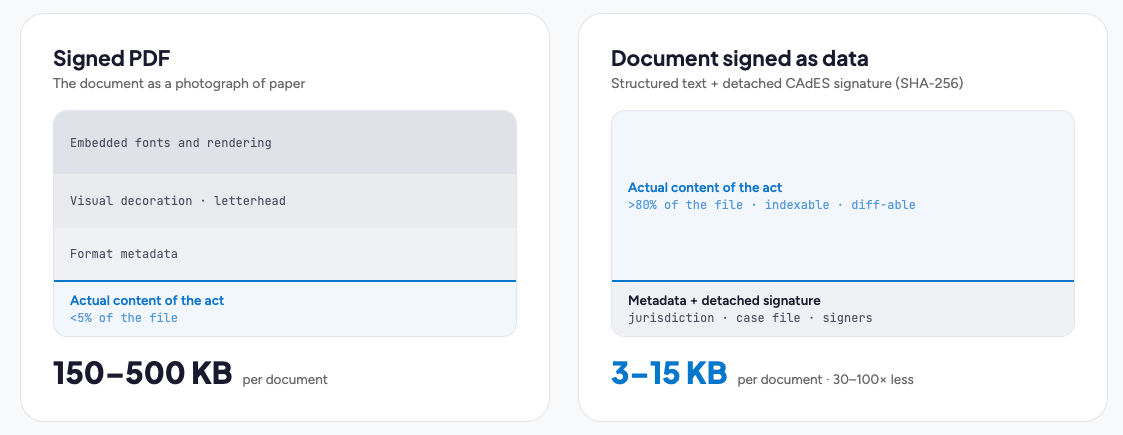
The actual content of an administrative transfer occupies just a few kilobytes. When that same act is wrapped as a signed PDF, the file can multiply its size dozens of times.
At state scale, that difference changes the entire economics of the system. A mid-size jurisdiction can go from consuming terabytes of storage per year to a fraction of that volume. Less storage, less compute, fewer servers and less dependence on specialized software.
Systems that withstand the peaks
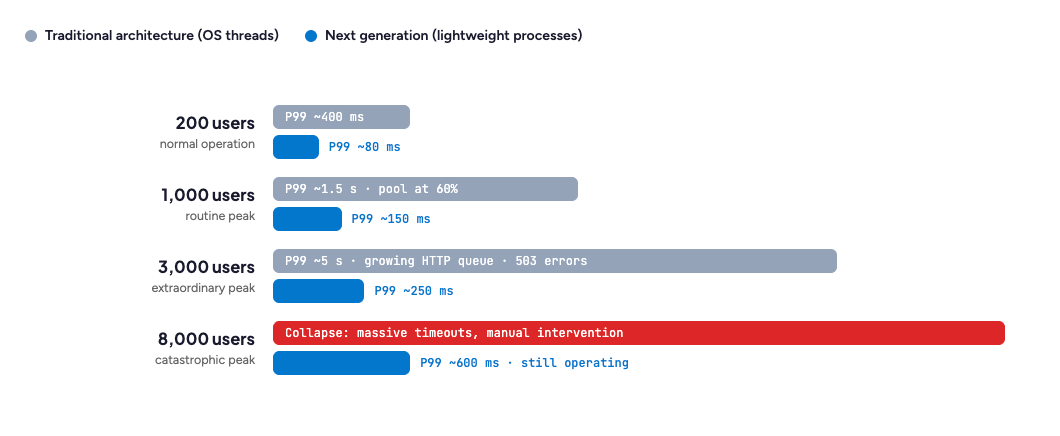
Administrative systems live on closes, deadlines and campaigns. The difference between a modern architecture and a legacy one shows at the moments of maximum demand, rather than in the average.
Built on massive-concurrency technologies, the system degrades gracefully under extraordinary load. For anyone working at a public office, the difference is simple: between “the system is slow” and “the system is down.”
Case files you can actually understand
When the document is born as structured data, it stops being an image and becomes usable information.
That enables full-text search across the entire corpus, semantic retrieval of related precedents, version-to-version comparison, and assistance drafting documents grounded in real regulations and case files — always under human review and signature.
The case file stops being an archive and becomes a source of institutional knowledge.
The act as signed data
The architecture we propose separates the content from its visual representation.
Every proceeding exists as signed data, accompanied by its metadata and protected by a digital signature issued by the same certification infrastructures operating today in each country. The legal proof remains the same: integrity, authorship, certification and traceability.
When an agency or external system needs a PDF, one can be generated on demand. The PDF becomes a representation; the legal evidence remains in the signature over the data.
The result is a model that is more efficient to process, simpler to archive, and better prepared to interoperate for the decades ahead.
How we build it at Sovra
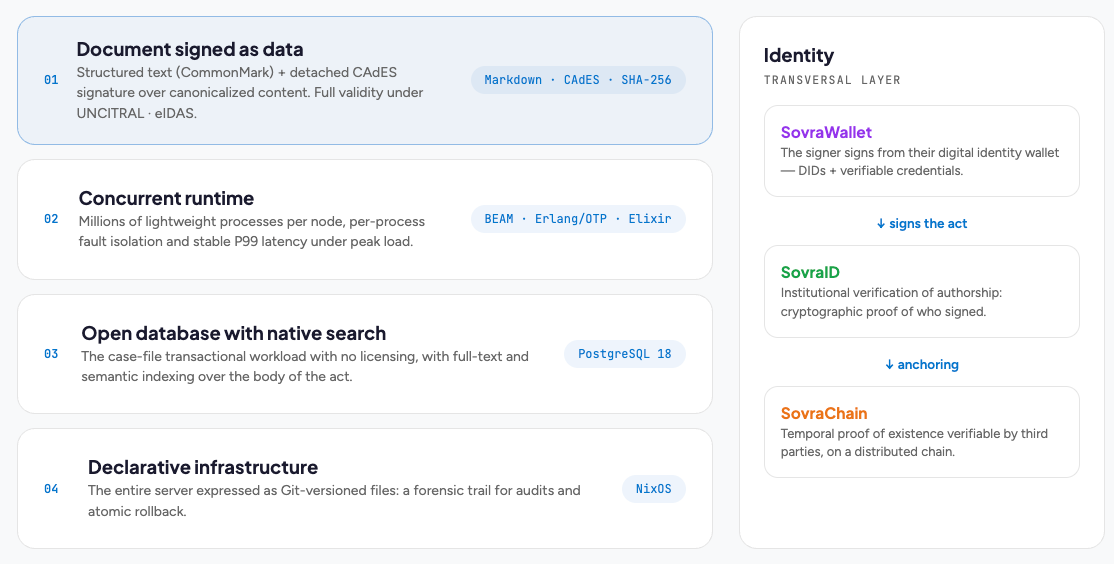
This is the architecture on which we build Document Management and the digital service Counter inside SovraGov.
Verifiable identity provides the proof of authorship. Verifiable credentials validate institutional signers. And cryptographic anchoring provides independent proof of existence and time.
Today this infrastructure already operates at scale: more than 10 million credentials issued, more than 50 million verifications processed, more than 8 million citizens and more than 20 governments using components of the stack.
As Aura Cifuentes put it on our podcast, Latin America’s digital public infrastructure moment cannot wait. And the case file is one of the places where that opportunity becomes most visible.
The most direct way to evaluate this thesis is to watch it operate: try a web demo on a real case file, end to end.
Continue the conversation
More on digital signatures, verifiable credentials and selective disclosure at sovra.io/knowledge.
If you are evaluating the modernization of document or case-file management in your province, reply to this email. We read every response.
Subscribe to The Identity Brief, published weekly.