

Privacy Is Not a Trade-Off
A quiet revolution in how identity verification works—and what it means for governments building digital services.

Something interesting is happening in how digital identity verification works, and it’s worth understanding because it changes what becomes possible when designing government services.
For a long time, conversations about digital identity have included an assumption that feels almost inevitable: that privacy and functionality exist in opposition.
This assumption has shaped how systems get built and how citizens experience government services. But a set of cryptographic innovations, now mature enough for production use, demonstrate that this tradeoff may no longer be necessary.
How Verification Has Traditionally Worked
When someone needs to prove they’re over 21, they show their entire identification document—full name, address, exact birth date, photo. When someone proves residency, they hand over utility bills filled with details far beyond what the verification actually requires.
This approach made sense given the tools available at the time. Physical documents bundle all information together, and there was no practical way to show just the relevant piece while keeping everything else private. Every verification became an all-or-nothing exchange.
The consequence: the more services someone accesses, the more copies of their personal information end up stored in different databases—each one a potential vulnerability if compromised.

A Different Architecture
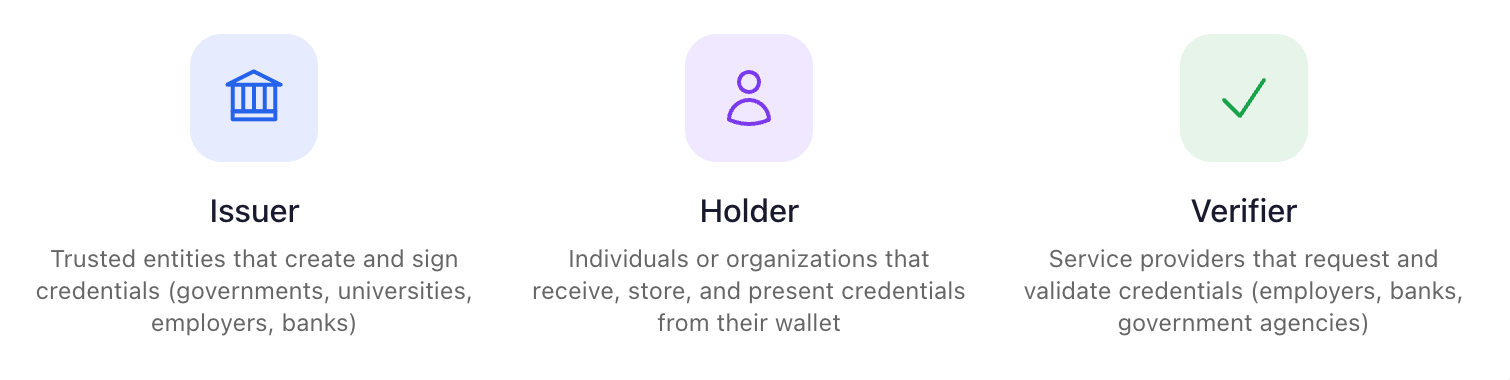
Modern Self-Sovereign Identity (SSI) systems operate on a three-party trust framework that changes these dynamics fundamentally.
Issuers are trusted entities (governments, universities, banks) that create and cryptographically sign credentials. Holders are individuals who store these credentials in their own digital wallet. Verifiers are service providers that validate credentials when needed.
The key innovation: when a verifier needs to confirm something, they check the cryptographic signature embedded in the credential itself. No need to contact the issuer. The mathematical proof is sufficient to confirm authenticity.
This means verification can happen instantly, at scale and without creating new data stores or dependencies on external systems.
Selective Disclosure and Zero-Knowledge Proofs
Here’s where it gets powerful. Verifiable Credentials combined with cryptographic techniques like BBS+ signatures enable something called selective disclosure, sharing only specific attributes rather than revealing everything.
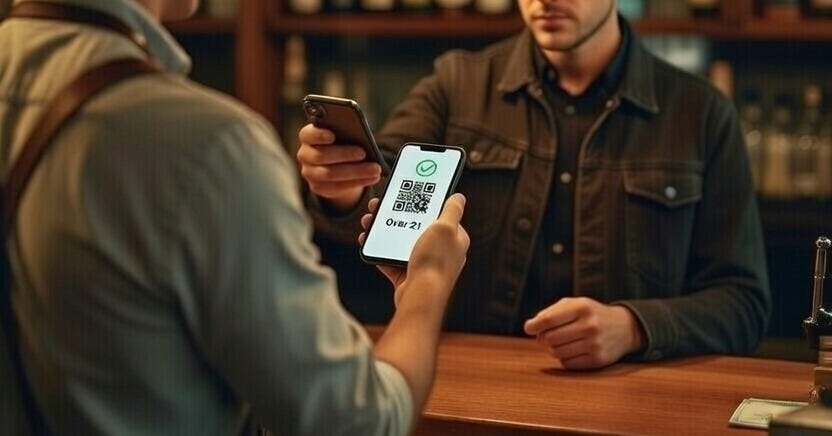
Consider age verification. With selective disclosure, a holder presents a Zero-Knowledge Proof that reveals only one thing: “Yes, this person is over 21.” The verifier receives mathematical proof that a condition is met, without ever seeing the underlying personal data.
For government services, this opens significant possibilities. Citizens could prove eligibility for programs, verify residency, or confirm qualifications. All without exposing sensitive personal details that then need to be stored and protected.
What This Means for Service Design
From an operational perspective, this architecture changes how services can work.
Verification becomes instant rather than requiring manual review. Governments no longer need to store copies of citizen data for every service, which eliminates breach risk for data that was never stored. Compliance simplifies when sensitive information never touches your systems in the first place.
New services become easier to deploy. Rather than each service requiring its own identity integration, data storage, and security infrastructure, services can connect to shared verification infrastructure. What might take 12-18 months under traditional approaches can happen in weeks.
The compounding effect matters: in year one, the difference might be a few additional services. By year five, one approach has enabled dozens of new services while the other is still working through integration challenges.
The Bottom Line: Privacy by Design
Recent Sovra deployments in Argentina, Mexico, and Colombia show how citizens in these regions verify their identity, access government services, and prove their credentials every day—while sharing only exactly what each situation requires. The results have been meaningful: 30% reduction in bureaucratic processes, services completing 80% faster, and zero data breaches.
This infrastructure operates on open standards—W3C’s DID and Verifiable Credential specifications—ensuring interoperability across systems and borders. Identity becomes portable, usable across services without repeated verification or platform lock-in.
For governments thinking about digital identity architecture, the question becomes less about whether privacy-preserving verification is technically possible—it is—and more about how to design systems that take advantage of these capabilities.
What aspects of this architecture are generating questions in your organization?
Radar Sovra
📄 Ethereum Foundation on What are zero-knowledge proofs? - Why Ethereum’s co-founder calls ZK “the future of identity”
🎙️ How Nuevo León Digitialized Services with Privacy and Transparency - The architecture behind privacy-by-design at scale
🎯 Interactive demo: Selective disclosure verification - Experience how SSI architecture works in real time.